
What creatine is
Creatine is a natural compound your own body makes from three amino acids: arginine, glycine and methionine. It is produced mainly in the liver and kidneys, and you also get it from food, mostly meat and fish.
The body produces around 1 g per day and an omnivorous diet provides a similar amount. Around 95% of the body’s creatine is stored in skeletal muscle; the rest is spread across tissues with a high energy demand, such as the brain and the heart.
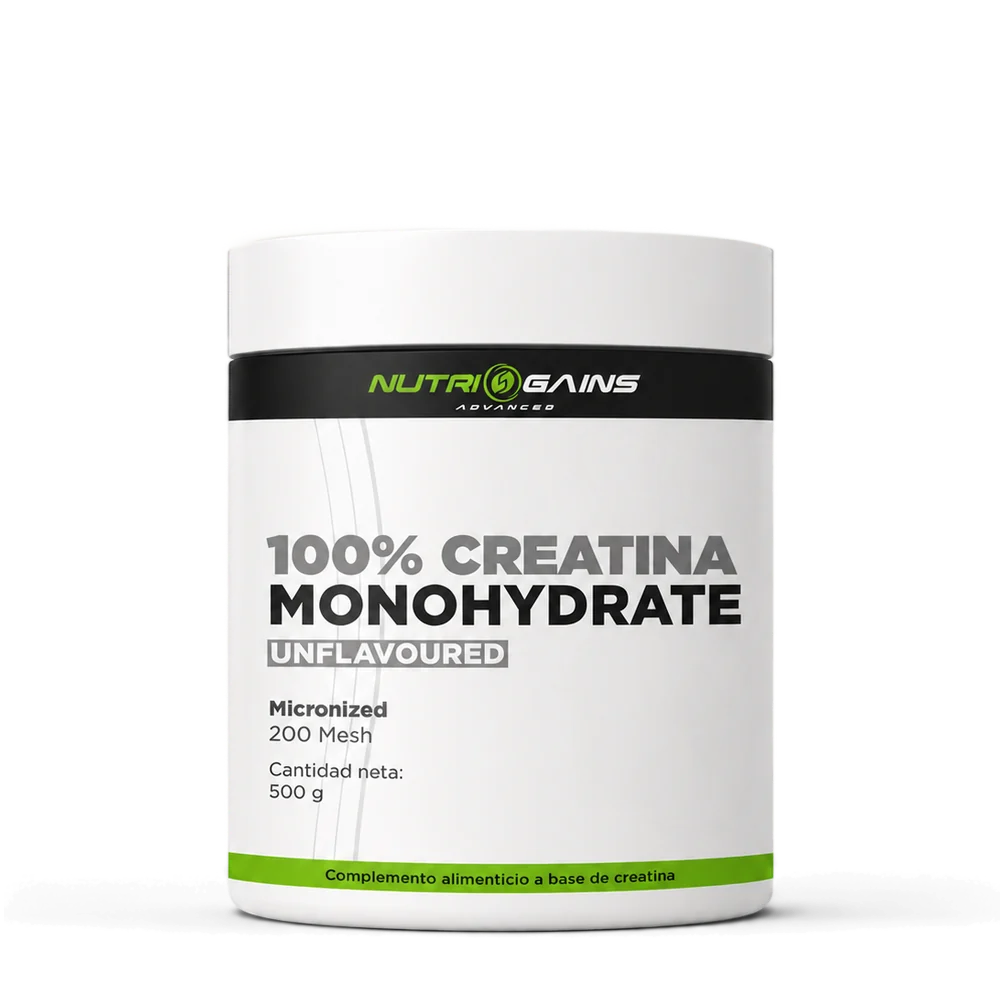
The most widely used form as a supplement is creatine monohydrate: a creatine molecule bound to a water molecule. It is the form used in the vast majority of scientific studies and the one with the strongest backing.
How it works: the phosphocreatine system
Your cells get their energy from ATP (adenosine triphosphate). The catch is that muscle only stores enough ATP for a few seconds of intense effort. That is where creatine comes in.
Inside the cell, creatine binds to a phosphate to form phosphocreatine, a ready-to-use energy reserve. When the effort is intense, the enzyme creatine kinase transfers that phosphate to ADP and regenerates ATP instantly. During recovery, the reaction reverses and the reserve recharges.
It is the body’s fastest energy system: the one in charge during the first seconds of a sprint, a heavy set or a change of pace. The fuller your phosphocreatine reserve, the more immediate energy you have available set after set.
Benefits recognised by European regulation
In the European Union, a nutrient’s benefits can only be communicated if the European Food Safety Authority (EFSA) has assessed them and the Commission has authorised them. Creatine has two:
Creatine increases physical performance in successive bursts of short-term, high intensity exercise.
The beneficial effect is obtained with a daily intake of 3 g of creatine. Intended for adults performing high intensity exercise.
“Successive bursts of short-term, high intensity exercise” describes exactly what most people who train do: strength sets, sprints, interval training (HIIT), CrossFit or stop-start sports such as padel, football or tennis.
Daily creatine consumption can enhance the effect of resistance training on muscle strength in adults over the age of 55.
With 3 g of creatine per day in conjunction with resistance training that increases the workload over time, at least three times per week for several weeks, at an intensity of at least 65-75% of one repetition maximum.
This second claim makes creatine an ally of active ageing: combined with strength training, it helps enhance the effect of training on muscle strength from the age of 55.
Beyond the gym
Creatine is no longer just for athletes. Because of its role in cellular energy, it is relevant to very different profiles:
- Women: creatine has been studied in adult men and women, and the dose is the same, 3 g per day.
- Adults over 55: together with strength training, it has a specific benefit recognised in the European Union.
- Vegetarian and vegan diets: since dietary creatine comes mainly from meat and fish, people who don’t eat them start from a lower dietary intake, and supplementation is a direct way to cover it.
- Biohacking and the brain: creatine’s role in the brain’s energy metabolism is one of the most active lines of research. We cover it in Creatine and the brain: what the science says.
How much creatine to take per day
The reference dose is 3 g per day: the amount at which European regulation recognises the effect of creatine on performance. With our creatine, that is one scoop.
Research usually works with maintenance doses of between 3 and 5 g per day. With 3 g you get the dose backed by the authorised claim, in a single serving and without complications.
Do you need a loading phase?
No. With 3 g every day, your creatine stores fill up progressively over about four weeks. It is the most comfortable and consistent way to reach the same point.
When and how to take it
The key to creatine is consistency, not the clock. It works by accumulation: what matters is keeping your stores full day after day.
- Timing: whenever suits you. In the morning, after training or with a meal. Pick a fixed moment so you don’t forget it.
- With what: in a glass of water, juice or your shake. Quality creatine monohydrate has no taste.
- Rest days: those too. Keeping up the daily serving is what maintains your stores.
- Continuously: no cycles or breaks, as one more habit in your routine.
In the NG Advanced ritual, creatine takes the central moment of the day: omega-3 in the morning, creatine during the day and magnesium + B6 in the evening.
How to choose a quality creatine
Every label says “creatine”, but they are not all the same. These are the four points that make the difference:
| Criterion | What to look for |
|---|---|
| Form | Creatine monohydrate, the most researched form. |
| Purity | A single ingredient and the highest possible declared purity. |
| Particle size | Micronised: it disperses better and is easier to mix. |
| Additives | No sugars, flavourings or colourings: just creatine. |
If you want to understand exactly what “micronised 200 mesh” means, we explain it in Micronised creatine 200 mesh: what makes it different.
Safety
Creatine monohydrate is one of the supplements with the most safety studies. The International Society of Sports Nutrition (ISSN) concludes that its short- and long-term use is safe and well tolerated in healthy people at recommended doses.
When you start, your weight may go up slightly: muscle stores creatine together with water, inside the muscle fibre itself. It is part of how it normally works.
If you have kidney disease, are pregnant or breastfeeding, or are on medical treatment, check with your doctor first.
Frequently asked questions
What is creatine for?
Creatine increases physical performance in successive bursts of short-term, high intensity exercise, with 3 g per day. In adults over the age of 55, daily creatine consumption can enhance the effect of resistance training on muscle strength.
How many grams of creatine should I take per day?
3 g per day: the amount at which European regulation recognises its effect on performance.
Is it better to take it before or after training?
What matters is taking it every day. Choose the moment that suits you best and stick with it.
Do I need to take breaks?
No. Creatine is taken continuously, rest days included, to keep your stores full.
Can women take it?
Yes. Creatine has been studied in adult men and women and the dose is the same: 3 g per day.
Sources
- Regulation (EU) No 432/2012: authorised health claims
- Commission Implementing Regulation (EU) 2017/672: creatine and muscle strength in adults over 55
- EFSA (2016): creatine in combination with resistance training and muscle strength
- Kreider et al. (2017): ISSN position stand on the safety and efficacy of creatine
- Kreider et al. (2022): bioavailability, efficacy and safety of creatine
- Antonio et al. (2021): common questions and misconceptions about creatine, according to the evidence